Print Bench
My own 3D printing shop, and everything it runs on, built and looked after by me.
What it is
Print Bench is the 3D printing business I run from South Morang. People buy dice towers and desk pieces in the colours they pick, or send a file, a sketch or a broken part and get it printed. I’m the person who prints them, and I’m also the person who built the shop and keeps the server under it running.
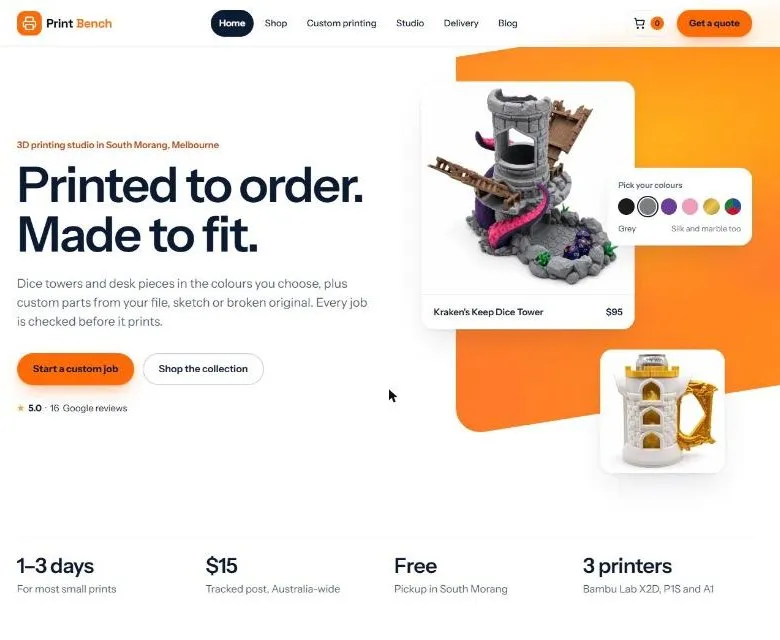
It’s WordPress and WooCommerce on the outside. Most of the work is in four plugins of my own, so the business rules survive a theme change.
The bits I’m proud of
Colour previews. Most products come in several colours per part, and a customer wants to see their combination before paying for it. I keep the original Bambu Studio project file private on the server, pull each part and its filament slot out of it, and have Blender render each saved view in the background: a neutral model, a map of which part covers each pixel, and the shadow. The browser then recolours those renders in about a tenth of a second whenever the customer picks a colour. Silk and metallic filaments get their own shading, so gold looks like gold rather than yellow.
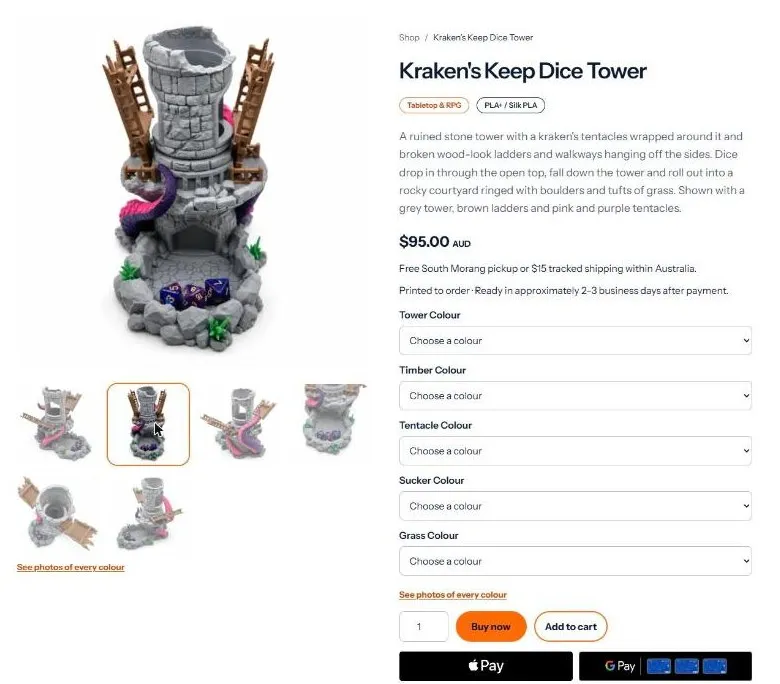
Lead times that are actually right. Each product has its own ready-stock and printed-to-order ranges. The shop works out the estimate from what’s in stock, how many you want, and what else is in the cart, and it counts stock other shoppers are holding at checkout.
Knowing where enquiries come from. Most people message on WhatsApp or email instead of filling in a form, so taps on those links are recorded on the server and tied to the page they came from. That’s how I know the website brings in work.
Local pages. Each suburb I deliver to or pick up from has its own page, written for the people who live there, because that’s how people search for a printer near them.
Keeping it running
It runs on the same server as my clients’ sites. Every night a backup is copied to two other machines at home, and my phone gets an alert if one is late. I’ve tested a full restore. Code changes go through git, and content changes are scripts I run on a staging copy first and then the same script on the live site, so nothing is hand-edited on one and forgotten on the other.
It’s also where I try things before I use them on anyone else’s business.